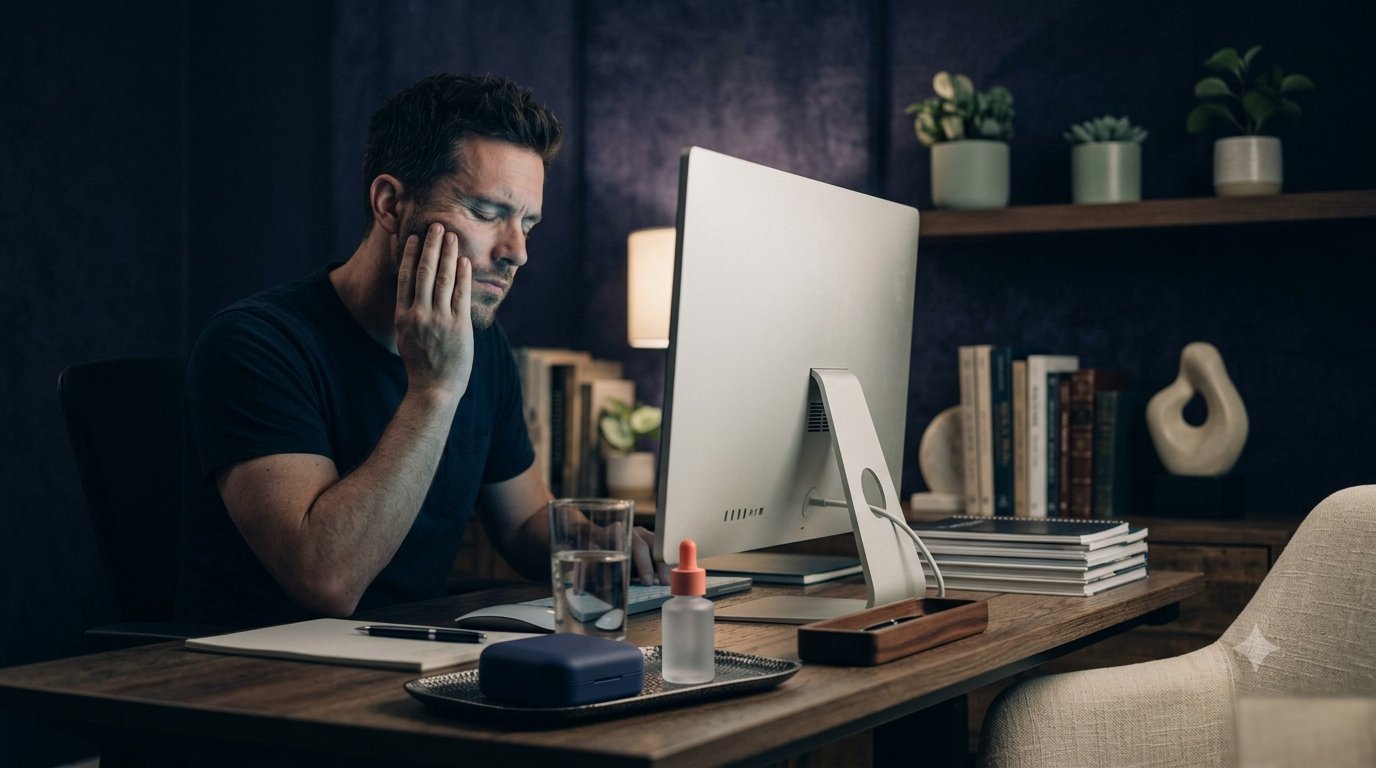
You're probably doing it right now
The jaw at rest should hang slightly open — lips together, teeth apart. If your teeth are touching as you read this, you're clenching. Most people who clench during the day have no idea they're doing it; the habit lives below awareness, switched on by concentration, stress, screens and deadlines, and it can run for hours at a time.
The masseter — the muscle you can feel bulge at the angle of your jaw when you bite down — is, for its size, one of the strongest muscles in the body. Held in low-grade contraction all day, it aches, refers pain up into the temples, and over months can visibly enlarge, squaring the jawline. That's why persistent clenchers so often arrive complaining not about their teeth but about headaches, facial tension and a tired jaw.
Why you clench
Awake clenching is overwhelmingly a stress and concentration behaviour — the jaw is where many of us physically hold tension, in the same way others hunch their shoulders. Caffeine, intense screen work, and anxiety all feed it. It's distinct from night-time grinding (sleep bruxism), which is driven by different mechanisms during sleep — and the distinction matters, because the two are managed differently.
What actually helps
For daytime clenching, the best-evidenced approach is habit reversal: repeatedly catching the clench and consciously releasing it, until the resting-apart position becomes the default again. Regular prompts — a note on your monitor, a phone reminder, our habit programme's nudges — sound almost too simple, but awareness training is the intervention with the strongest support for awake bruxism.
A thin daytime plate protects the teeth and acts as a physical reminder: every time you bite into it, you notice, and you release. Alongside that, managing the inputs — caffeine, stress, screen posture — and working the muscles directly (massage, warmth, trigger-point release) eases the symptoms while the habit retrains.
Not sure what your jaw is doing?
Our free three-minute consultation maps your symptoms, tells you whether you clench by day or night, and prescribes the right device — reviewed by a GDC-registered dentist.
Take the free consultation →When to seek care instead of self-treating: if your jaw locks or clicks painfully, if headaches are new, severe or worsening, or if you've had recent facial trauma, see a clinician first. Our consultation screens for exactly these and will route you to clinical care rather than sell you a device.